
Healthcare innovation is at its best when it takes on hard problems with curiosity, humility, and a clear-eyed focus on impact.
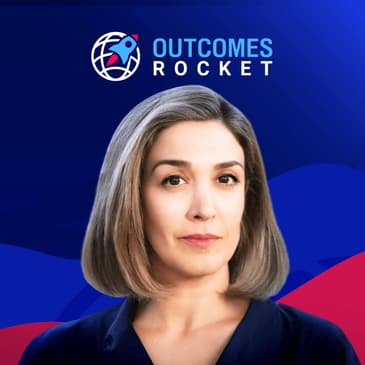
In this episode, Betsabeh Madani-Hermann, Global Head of Research at Philips, shares how complexity drives her passion for healthcare innovation. As the first female head of research in the company’s 135-year history, she leads breakthrough technologies and global partnerships to simplify care and scale impact. She explains how Philips’ innovation DNA helps move ideas from early exploration to real-world application. Betsabeh also highlights the use of pre-mortems to anticipate risks and emphasizes that the future of healthcare will be shaped by more than AI, including robotics, imaging, and human curiosity.
Tune in and learn why the best innovations come from staying curious, solving difficult problems, and preparing honestly for what could go wrong.
Resources:
[00:00:03] Hello, everyone, and welcome back to the Outcomes Rocket podcast. I'm excited to be with you for another episode. Today, I have the privilege of hosting the outstanding Betsabeh Madani-Hermann. She is the Global Head of Research at Philips, where she leads the company's breakthrough innovations, exploratory programs, and public-private partnerships.
[00:00:25] She's the first female head of research in Philips' 135-year history. She's a founder, investor, operator, and I'm excited to have her here on the podcast. Betsabeh, thanks for joining. Thank you for having me today. Of course. So I've been following a lot of your work and love the different things you're doing out there. What inspires your work in healthcare?
[00:00:47] I think at the core of it, we have intellectual curiosity and complexity. Healthcare is one of the most complex systems that humans have built, for good reason, to address a major pain point. And for me, a chance to simplify complexity at any point is quite inspiring. It's intellectually demanding in a way that doesn't get old. And it also, what's about it that's difficult, that actually makes it inspiring.
[00:01:14] And at the end of the day, the impact that you bring and every single patient, every single person who's in need of care that ends up receiving the care they need. That's what inspires me. I think that's a great inspiration and something that really pulls a lot of us in healthcare. When you think about Philips, what does the organization do to add value in the healthcare ecosystem that's different?
[00:01:37] Philips is one of the few organizations out there that's able to also achieve scale. So when we have a breakthrough innovation, when we have something exploratory that addresses a major unmet need, because of the access to the scale globally, it can sit at many different hospital systems in a short period of time.
[00:01:58] And that is a big deal to be able to reach health systems globally. And that multiplication of impact that makes it particularly interesting is also something that's unique about Philips amongst some of the larger organizations that play in this space and deliver that care. In addition to that, there is that history of innovation. And the 135 years you mentioned, May is roughly its birthday. It's coming up soon. Yeah.
[00:02:26] And since the x-ray tubes and the very first innovations that were happening in Eindhoven at Philips's first factory site to today, there is this underlying DNA in the company that drives every single person. I think, again, it goes back to that complexity. There's been a lot of highly curious individuals that have come and gone through the decades at the company, and they are always driven by what is a problem that we can solve through cool new innovation.
[00:02:54] Yeah. And that scale is big. I grew up in the medtech business and had the opportunities to partner with Philips back in my Medtronic days. Just a phenomenal company. And you guys continue to innovate every single year. As you do what you've been doing in the R&D space, talk to us a little bit about that, the pre-mortem practice that I've heard about. Indeed. So we have several venues for innovation inside the company, and two of those are Breakthrough Innovation Program as well as the Explore to Innovation Program.
[00:03:24] And one of the things that have become more and more of a practice in them is we run what's called an exploratory innovation premortem for each of those projects. Basically, when a project is selected, within the very first few weeks of saying, hey, congratulations, you're going to be now part of our program, we also say, we're going to pretend we killed you. In three years from now, this project doesn't exist anymore. Let's see what are goals and let's do an autopsy of why it doesn't exist and what made it fail.
[00:03:49] So we look at the failure right in its face in the first few weeks, instead of just celebrating and being on the highs of this is amazing, we are going to be taking on this new journey. We try to stop it and make it fail right away. And that allows us to identify two buckets of statements and things. Some of them are about things that are within our control. And then there is another group of things that are outside of our control. And that distinction also helps.
[00:04:15] For those boulders that are ahead, that are within our control, we try to remove them early on. That way we increase the chances of success of something exploratory. For those that are outside of our control, awareness alone and being able to find the right partners that helps us prevent them or at least address them when they occur or not be surprised, that's very helpful. And interestingly enough, we've actually ran premortem on research as an actual function as well. So if we think about... Oh, really? So it's, I would say... Shutting it down.
[00:04:45] Shutting it down. Shutting it down tomorrow. What has been the reasons that led to that? And we teach this to also other groups because it's always really helpful to be able to think about what are your weak spots and what are the things that may be in your control to do about those weak spots. And then also, again, be aware of the things that are not in your control yet awareness is already... So I love this, by the way. This is so non-standard. And really, where are the industries...
[00:05:14] History is going, you need non-standard thinking to really advance to where you need to go. So what has been one of the biggest ahas that has come out of this practice for you thus far? Of course. One of the things that I hadn't, for example... I'll give you a broader philosophical answer after I'll give you a more practical brief. Okay. Yeah. I like this. Let's do it.
[00:05:36] One of the things that I've done is we didn't know, for example, that procurement would be something we need to pay attention to. That's usually made for bigger product lines, not necessarily something that's exploratory and early stage. But through one of the premortems, we identified, well, hold on. Premortem could be... This premortem identifies that procurement is something we need to pay attention to because it could be that it would be too slow and we miss a milestone on timeline because something that was supposed to be brought in couldn't be brought in.
[00:06:02] And so those relationships and who do we need to talk to, who do we need to educate happened early enough and that was very helpful. On a broader scale, there are often many individuals, and this is the biggest learning, many individuals who come in exceptionally bright-eyed, hopeful, and that's how it should be. When you have something fantastic you're looking at building, when there's a problem that you're looking the problem in the face and you're saying, I'm going to be solving you because we have all the right tools around this and all the people who are going to think the right way around it.
[00:06:30] That creates also some of its own blind spots, and the premortems have helped us watch for those blind spots. And removing that element of surprise as much as we can and being prepared for it has been one of the best outcomes of it. And what I see is many folks that come to the program and run a premortem, they actually go and implement it across their own things outside of our programs as well, outside of this research ecosystem, into their daily jobs. And that's also really great to see.
[00:06:59] It helps people ask the right questions, prepare for disaster, prepare for things that should not be a big problem potentially, and you could solve them in advance. That's great. Folks, something to be thinking about in your own business, in your own organization. When is the last time you ran a premortem? If you have, we want to hear about it when this goes live. And if you haven't, why don't you do it? This is something that I'm thinking for myself and our business, and certainly one that I feel you should be inspired to do.
[00:07:28] Speaking of premortems, talk to us about setbacks. That's about what's one of the biggest setbacks you've had to deal with and a key learning that's come from that. One of the setbacks that we recognized, and it took us a while to actually recognize, is when we run a premortem, there is also an expectation that comes with it of, okay, well, you've now de-risked everything, so that means automatic success.
[00:07:50] That could give a sense of false confidence, and it also can give a sense of expectation that's maybe beyond what the reality actually is. When we do exploratory innovation programs or breakthrough innovation programs, they live and die by their milestones. If they miss a milestone, we have to stop. And sometimes, no matter how prepared you are, the milestones are missed for various different reasons. It could be that strategy changes. It could be a team expected to, for an answer to go left, but it goes right.
[00:08:18] It could be that you're looking for something positive, but it ends up being a negative result. And those milestones, especially in the smaller projects that have a shorter timeline, mean that we will stop the project at that moment. It also means that there has been this expectation that when you've done the premortem, you've already prevented this. So there is this sense of, okay, well, we thought we were going to be able to finish the project. And so that's been a setback, the education around it, that we reduce the amount of risk, but that doesn't eliminate the risk.
[00:08:47] And there are times that you also still have to act fast, stop projects that are not working, and make sure that then you put the focus, the resources, and the energy on the ones that are still quite valuable and they're moving forward. Yeah, that's such a good one. That's been like nothing is foolproof, folks. But if you spend the time to think about these things, get proactive, it reduces your risk, but nothing is foolproof. So I love your point there.
[00:09:14] And so with this idea of the future and how fast things are moving, what would you say is a healthcare trend or technology that you think is going to change healthcare as we know it today? I know quite a few people will say AI, but I actually think robotics combined with AI is still at its infancy. And I think there is a lot when it comes to basic physics as well that ends up coming into the future of healthcare.
[00:09:40] One of the places where one of my colleagues and I have often talked about is magnetic resonance imaging is still probably at its infancy. There is so much more that could be achieved with it. So I think of the physics of imaging, but also I think of robotics, procedural automation, be it in surgical robotics, be it in various different hospital ecosystems. But robotics has a major role to play in the future of healthcare as well. Yeah, I love that. That's a bit.
[00:10:07] And do you mean on all fronts, like from manufacturing to care delivery? I mean, on all fronts. Absolutely. On all fronts. You can have it. Robotics is already in various different field uses. It is already in manufacturing. They are robots that move equipment from places to places. Depending on the country, sometimes robotic exoskeletons are being used by folks.
[00:10:31] So I mean, on the nanoscale all the way to the big robotics that actually move things that are too heavy and could create back injury. Love that. Just so we're scratching the surface right now. 100%. Love that. Well, exciting to think about that future, folks, for all of you into robotics. You're probably like, yes, tell us more. And for those of you that aren't, something to look into. So Betsabeh, such a pleasure to be with you today. And I really appreciate you taking the time to do this.
[00:11:01] Leave us with a closing thought and what you feel is the best way that the listeners can connect with you. The best way to connect with me is via LinkedIn. I've had it since very early days of LinkedIn. So feel free to connect with me and the Philips team on LinkedIn. And the closing thought I have is what has driven me throughout my career. And I think has been satisfying in many ways is picking a work that is intellectually demanding. We live one life and it's important to live it to the fullest.
[00:11:29] And the impact that life can have on a human level is also important. And it's what makes the daily activities worthwhile. So pick something that's intellectually demanding. Try hard problems and stay as curious as you can. I love that. That's a great way to close, Betsabez. Let's all stay curious. Now is the time to really make a difference. If today's episode resonated with you, share it with a friend.
[00:11:54] All the ways to get in touch with Betsabez, as well as the short notes on today's conversation are in the show notes. So make sure you check those out. Thank you all for tuning in. And Betsabez, thanks for spending time with us. Thank you, Sal. It was great to be on your show.